
Impacted Canines in Washington, D.C.
Table of Contents
- Real Stories: Impacted Canine Treatment Reviews
- Why Choose Capital Center® for Your Impacted Canine Treatment?
- Book Your Impacted Canine Consultation
- What Are Impacted Canines?
- Benefits of Impacted Canine Treatment
- Who Is an Ideal Candidate for Impacted Canine Treatment?
- What Is Impacted Canine Treatment Like?
- Impacted Canine Surgery: Surgical Exposure & Bracketing
- Impacted Canine Surgery Recovery
- Impacted Canine FAQs
Real Stories: Impacted Canine Treatment Reviews
Dr. Emery is incredible. He’s changed my life.
I’m congenitally missing my lateral incisors, and I had a very difficult case with gaps, but very tight spaces for implants—many said implants weren’t possible. I saw countless doctors and had failed surgeries before him. Dr. Emery was able to make implants work for me. The technology he’s developed at his office enables extreme precision in tough implant cases like mine.
That was back in 2012. I see him annually for check-ups, and everything is looking good. Definitely worth the money. He’s the best there is. I cannot speak highly enough. One of the best decisions I’ve made.
— L.M., Google Review
Dr. Emery and his team implanted 4 teeth in my upper jaw. Judging by the results, it is clear that Dr. Emery is a very gifted surgeon—and the whole process was amazingly painless. In addition, Dr. Emery proved to be a clear and thorough communicator, taking the time to explain the why and how of each phase of the treatment, and sharing his enthusiasm for the state-of-the-art tools being developed. The administrative part of the process (including providing documentation for insurance purposes) was handled efficiently by the staff. I am most happy with the entire experience, and do not hesitate to recommend Dr. Emery and the Capital Center®. Thank you!
—P.C., Google Review
Why Choose Capital Center® for Your Impacted Canine Treatment?
At Capital Center®, technology is a primary tenet of our practice philosophy, not because it’s easier, but because it improves patient experience, enhances safety and accuracy, and reduces post-operative pain and complications. Our incorporation of the X-Guide® system also makes complex impacted canine cases both possible and successful.
Dr. Robert Emery is one of the founding developers of the X-Guide® system, drawing on his experience as an oral and maxillofacial surgeon and implantology expert to create technology that benefits patients and surgeons alike. Capital Center® is a global leader and educator in computer-assisted oral and maxillofacial surgery, including advanced impacted canine cases.
Book Your Impacted Canine Consultation
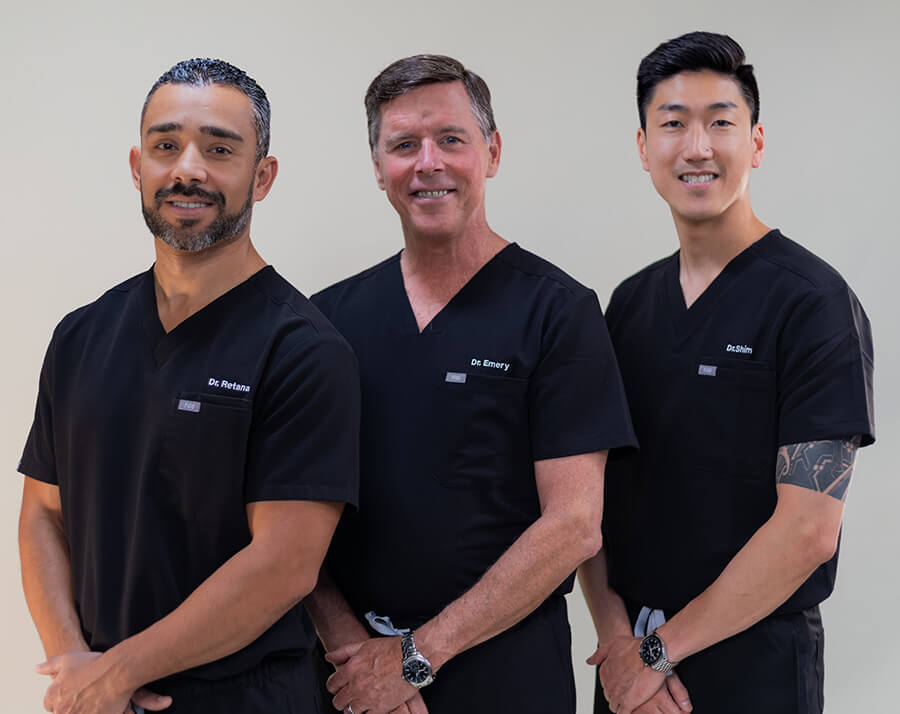
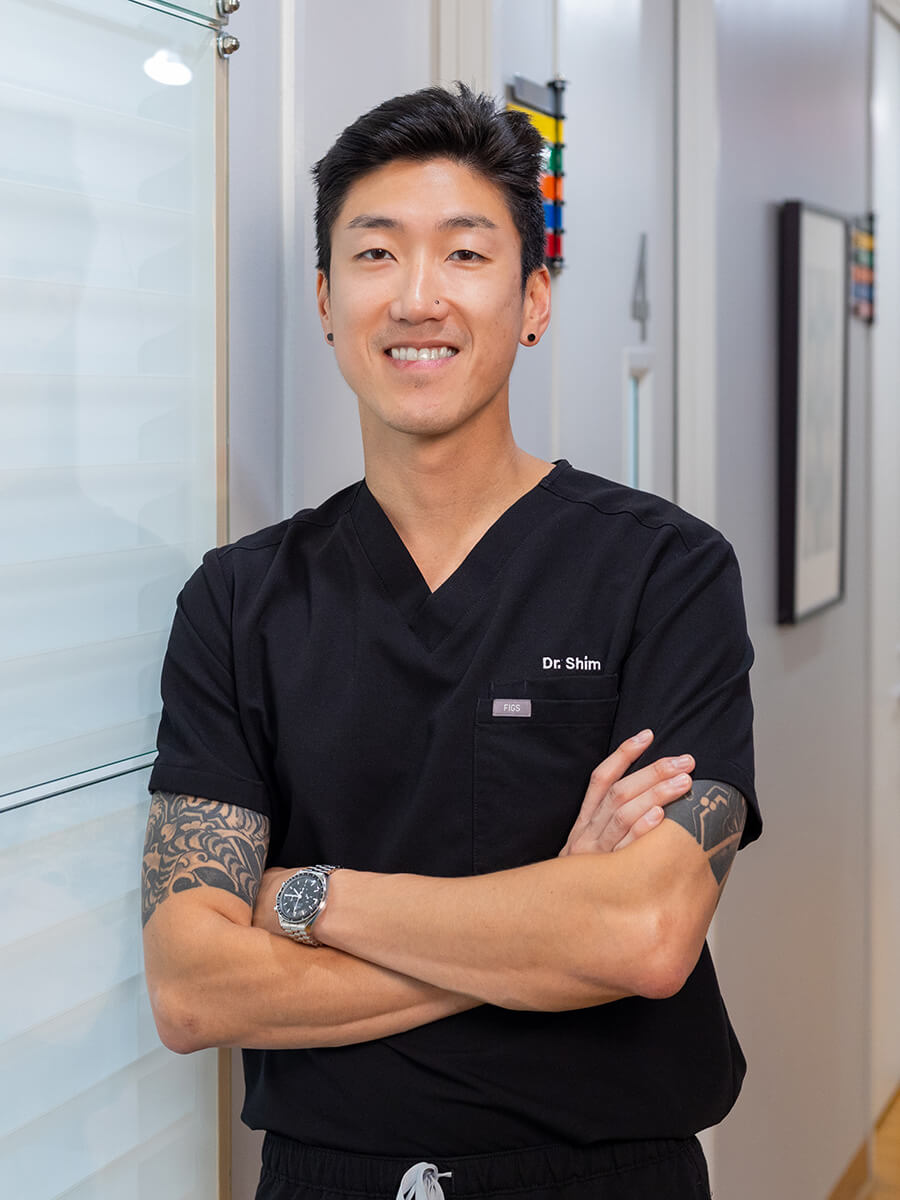
Drs. Emery, Retana, and Shim are ready to help you achieve a healthy, functional smile with minimal pain and a quick recovery by treating your impacted canines. Call Capital Center® today at (202) 386-7100 or complete the contact form to request a consultation and learn your options.
What Are Impacted Canines?
An impacted canine is a permanent (or adult) tooth that fails to erupt properly or descend into its natural space by the rest of the teeth. The upper canine can remain trapped beneath the gums or in the jawbone. This is commonly caused by overcrowding. The earlier it is addressed, the better, as impacted cuspids can be recognized by a child’s primary dentist and be treated by an orthodontist by creating space in the jaw, allowing the canine to erupt and descend naturally.
Benefits of Impacted Canine Treatment
Treating impacted canines is essential for long-term oral health. The benefits of treating your impacted canines include:
- Ensuring proper biting and chewing function
- Preventing damage to tooth roots
- Improving long-term health by saving the natural tooth
- Enhancing aesthetics by straightening teeth
When indicated, our team’s use of the X-Guide® system offers the following benefits:
- Minimally invasive surgery
- More precise diagnosis of the impacted tooth location and position
- Enhanced visualization during surgery
- Reduced surgical risk, pain, and post-operative discomfort
- Faster surgical time

Who Is an Ideal Candidate for Impacted Canine Treatment?
Adults and children with impacted canines may be candidates for various treatment options, either surgical or minimally invasive. Your candidacy for treatment may be determined during a routine dental exam or after a consultation with one of our oral and maxillofacial surgeons. Some patients may experience pain, swelling, or discomfort in their gums near their impacted canines and/or the surrounding teeth.
Diagnosing impacted canines requires dental imaging, such as panoramic X-rays or CBCT scans (3D cone beam CT scanning). 3D CT scans are an essential step in the process, as these detailed images of your jaw and mouth are used to communicate with our X-Guide® system, the advanced surgical technology that improves surgical accuracy and reduces surgical risks, post-operative pain, and surgical time.
What Is Impacted Canine Treatment Like?
Treating your impacted canines depends on several factors, including your age, the location of the canines, the cause of the condition, and whether you have previously received ineffective treatment. Typically, if the patient is a child or young teen, treatment involves a combination of orthodontics to make space in the mouth for the impacted canine, and surgery to expose and guide the tooth into place.
There are multiple options for treating impacted canines, including:
Surgical Exposure & Bracketing
For this option, we make a small incision to expose the impacted tooth. Next, a small metal chain is attached to a small bracket on the exposed canine. Lastly, your orthodontist uses brackets to gradually pull the chain and the tooth into the correct position.
Extraction of Primary Teeth
In some cases, there are baby teeth or supernumerary (extra) teeth in the way of the exposed canine, preventing it from descending on its own. This method involves removing the impinging teeth to create space for the impacted canine.
Accelerated Alveolar Orthodontics (AAO)
If an impacted cuspid is not treated in adults, the likelihood that it will erupt on its own diminishes drastically. This condition is called ankylosis.
In these cases, oral surgeons and orthodontists can attempt to encourage tooth eruption in a multistep process called accelerated alveolar orthodontics (AAO). The oral surgeon exposes the impacted tooth and makes small cuts (scoring) in the surrounding bone, performs bone grafting to promote tooth movement, and then aids the tooth’s movement with successive orthodontic treatment to guide it into place.
Luxation & Extraction of the Impacted Tooth
If there is little chance of the tooth erupting or responding to other treatments because it is severely impacted, then the only treatment is to luxate it (gently wiggle it) to dislodge any bone fusion. A final attempt is made to erupt the tooth. This rarely works. At this point extraction is the only option. The X-Guide® system makes this process much more precise, reduces trauma to surrounding areas, and is essential for the next step in restoring your smile with a dental implant to replace the impacted tooth.
Impacted Canine Surgery: Surgical Exposure & Bracketing
Step 1: Consultation, Surgical Plan, & Orthodontics
The most common technique for treating impacted cuspids is surgical exposure and bracketing, a team effort between your oral surgeon and your orthodontist. You likely will have had diagnostic imaging performed, or you are experiencing discomfort due to your impacted canine.
After a consultation with your orthodontist or oral surgeon, you will likely have braces placed on the teeth surrounding the canine, usually the upper arch. After some time, a space for the canine will be opened. Next, you’ll be referred to us for oral surgery.
Step 2: Surgical Exposure & Bracketing
Next, your surgeon will expose the impacted tooth by lifting up a section of the gum. If a baby tooth is present, it will be removed. Once the tooth is exposed, the surgeon will bond an orthodontic bracket to it. The bracket has a tiny chain connected to it, which will be attached to the dental arch.
In some cases, the surgeon will leave the exposed tooth uncovered by suturing the gum up above it or by making a window in the gum. Most of the time, the gum will be returned to its original location over the tooth and sutured, with only the change remaining visible.
Step 3: Continued Orthodontics & Tooth Descension
Shortly after surgery, you will return to your orthodontist, who will place a rubber band on the chain to put tension on the exposed tooth and guide it into place. This is a slow, controlled process that may take up to a full year to complete. Once the tooth is in place, the gum will be evaluated to ensure it is healthy and strong enough to serve its function. In some cases, additional gum grafting may be necessary to adequately bolster it.
Impacted Canine Surgery Recovery
Surgery to expose and bracket an impacted tooth is very straightforward and performed in our office. We typically use nitrous oxide (laughing gas) and local anesthesia, or IV sedation, if preferred. The procedure typically takes an hour if only one tooth is exposed and 30 minutes if bracketing is not required.
After surgery, some minor bleeding in the surgical sites is common. There may be minor discomfort, but this can be relieved with over-the-counter pain medications like Tylenol or Advil. If EXPAREL® is used there will be minimal to no discomfort. Any swelling of the lip can be managed with cold compresses, but bruising is uncommon. You will be given specific after-care instructions, including how to maintain good oral hygiene during recovery.
General guidelines include the following:
- We recommend a soft, bland diet during the initial healing phase.
- You may resume your normal diet as you feel comfortable chewing.
- Avoid sharp, crunchy foods like chips or crackers, as they may hurt your surgical site.

Impacted Canine FAQs
Why is early identification of impacted canines important?
Recent studies have revealed that early identification of impacted teeth (including those other than wisdom teeth) should prompt treatment at a younger age. Once the general dentist or hygienist identifies a potential eruption problem, the patient should be referred to the orthodontist for early evaluation.
In some cases, the patient will be sent to the oral and maxillofacial surgeon before braces are even applied to the teeth. As mentioned earlier, the surgeon will be asked to remove over-retained baby teeth and/or selected adult teeth. He will also remove any extra teeth or growths that are blocking the eruption of the developing adult teeth. Finally, he may be asked to simply expose an impacted eye tooth without attaching a bracket and chain. In reality, this surgical procedure is easier than exposing and bracketing the impacted tooth. This will encourage an eruption before the tooth becomes fully impacted (stuck).
By the time the patient is at the proper age for the orthodontist to apply braces to the dental arch, the eye tooth will have erupted enough that the orthodontist can bond a bracket to it and move it into place without needing to force its eruption. In the long run, this saves the patient time and means less time in braces, which is always a plus.
How can I prevent my child from needing impacted canine surgery?
The older the patient, the more likely an impacted eye tooth will not erupt by nature’s forces alone, even if the space is available for the tooth to fit in the dental arch. The American Association of Orthodontists recommends that a panorex screening X-ray and dental examination be performed on all dental patients around age seven to count the teeth and determine whether there are problems with the eruption of adult teeth.
How can you tell if a child will have impacted teeth?
It is important to determine whether all adult teeth are present or some are missing. Are there extra teeth present or unusual growths that are blocking the eruption of the eye tooth? Is there extreme crowding or too little space available, causing an eruption problem with the eye tooth?
This exam is usually performed by your general dentist or hygienist, who will refer you to an orthodontist if a problem is identified. Treating such a problem may involve an orthodontist placing braces to open spaces to allow for the proper eruption of the adult teeth.
“The greatest measure of success is a patient who trusts you completely and moves forward in life with confidence.”